Home Regions of OntarioOttawa and Countryside Region
Ottawa, Ontario
Ottawa, a beautiful city, steeped in history is the capital of Canada. The name Ottawa is derived from Odawa (meaning traders), an Algonquian-speaking indigenous people that lived in the upper Great Lakes region including Manitoulin Island, Lake Huron and Georgian Bay during the time prior to European settlement. The Ottawa River, known as Kichi Sibi, meaning Great River in the Algonquian language provided an easy means of transportation and facilitated trade among the Odawa and their Algonquian speaking neighbours the Ojibwa and the Potawatomi.
While many parts of Ontario were being settled by Europeans and Americans, the area around Ottawa was still a forested wilderness. In 1800 Philomen Wright came to Canada from Massachusetts and settled at the present site of Hull, Quebec (then Lower Canada). Hoping to establish a farming community he soon discovered the lumber business was quite lucrative and he turned his energy to building a mill along the Ottawa River and harvesting the timber that was so plentiful in the area. More settlers would follow in the hope of finding work in the lumber trade and the tiny community of Wrightsville continued to grow.
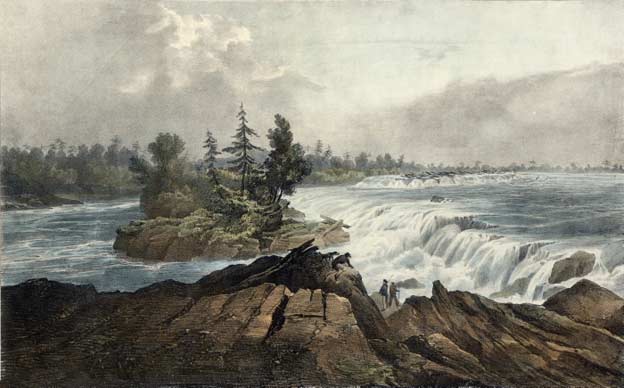
Chaudiere Falls, Ottawa River, Upper Canada
Courtesy of the Toronto Public Library
A group of Royal Engineers under the direction of Lieutenant-Colonel John By established a construction site for the Rideau Canal on a 30 metre bluff near Chaudière Falls and the mouths of the Gatineau and Rideau rivers in 1826. When By arrived the area now known as Hull was already an established farming community, headed by Philomen Wright. Three thousand acres had been cleared, homesteads had been built and the settlers were thriving.
Lieutenant Colonel John By had worked previously in Quebec and was second in command when the Martello Towers on the Plains of Abraham were built. During the war of 1812 he had been recalled to Britain where he performed the duties of a Royal Engineer. In 1826 Colonel By received word that he had been selected to head the team of engineers that would build the Rideau Canal. That summer he set sail from England with his wife and young daughters arriving first at Quebec and then accompanied by Lord Dalhousie, up the Ottawa River by steamer to Wrightsville, where the entire community including Philomen Wright gave them a royal welcome.
The first order of business for Colonel By was to build a bridge over the Ottawa River. Union Bridge, would become the largest bridge in the country and the only means of connecting Lower Canada to Upper Canada, the two being separated entirely by water.
A town was laid out by Colonel By and Irish labourers were hired to build barracks for the workmen. Cabins were constructed for the families of workmen and a community known as Bytown, in honour of Colonel By soon emerged. Just two years later there were a hundred and fifty houses and fifteen shops in Bytown.
Colonel By named Wellington Street in honour of the Duke of Wellington, Dalhousie for the Governor, and Sussex for his homeland in England. 1855 Bytown was incorporated into a city and the name changed to Ottawa. Bytown's name was changed to Ottawa in 1855, following its incorporation as a city.
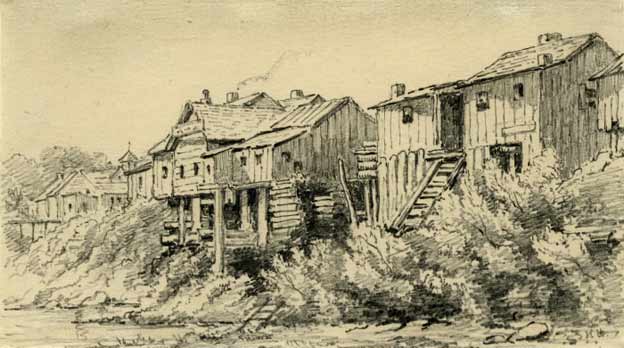
Bytown, 1876
Courtesy of the Toronto Public Library
Ottawa started out as several settlements. Upper town, west of Parliament Hill, then called Barracks Hill, was the home to many of the wealthy merchants and contractors. Lower Town, east of the canal along Rideau and Sussex streets was a community made up of mostly workers employed in the timber trade and the building of the Rideau Canal.
Corktown, a double row of huts and shanties along the bank of the Rideau Canal was where some of the poorest settlers lived. Named after County Cork in Ireland the shanty town existed until the completion of the canal in 1832 when most of the labourers moved to lots set up by Colonel By or pulled up stakes to look for work elsewhere.
New Edinburgh was east of the Rideau River and is where Thomas McKay built several mills and his manor house known as the Castle. McKay's manor house would eventually become Rideau Hall and the official residence of the Governor General of Canada. MacKay's son-in-law built a home named Earnscliffe which would become the residence of Sir John A. MacDonalad, Canada's first prime minister. After his death Queen Victoria gave his widow the title of Baroness Macdonald of Earnscliffe.
As the citizens of Bytown busied themselves with the building of roads, canals and railways the British North American Act or the Act of Union in 1840 unified Upper Canada and Lower Canada into the united Province of Canada. The new union was looking for a capital and there were several contenders. Quebec City had always been the source of power in Lower Canada and assumed the title would go to them. Kingston, York (Toronto) and Montreal were also considered. There was much debate about which city to choose as a capital. The issue was resolved by Queen Victoria in 1857 when she selected the smaller backwoods community known as Ottawa as the nation's capital.
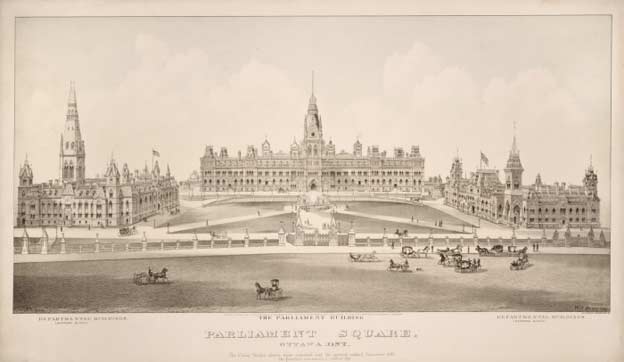
Parliament Square, 1879
Courtesy of the Toronto Public Library
Not everyone was pleased with this decision. Goldwin Smith, a prominent scholar who resided at the Grange in Toronto wrote Ottawa was "a sub-Arctic lumber village converted by royal mandate into a political cockpit".
In 1859 work began to build a permanent base of government. The stone barracks on Barracks Hill were torn down and replaced with a series of beautiful stone Gothic buildings. Barrack Hill became Parliament Hill. The main building along the brow of a cliff, housed two chambers, the Senate who were appointed for life and the elective House of Commons. The east and west were separate blocks containing administrative offices.
After several years the buildings were completed and in 1866 the parliament of Canada had found a permanent home. On July 1, 1867 the British Colonies of Canada, New Brunswick and Nova Scotia were united into one Dominion of Canada and Ottawa was now the nucleus of all federal government.